
Diversity, Equity, and Inclusivity Principles
DEIB Work at Willamalane
Willamalane proactively works to foster welcoming parks, facilities, and programs, so that all of our community members and staff have access to the same opportunities and feel a genuine sense of belonging.
Willamalane’s mission is “To deliver exceptional parks and recreation to enrich the lives of everyone we serve.” DEI is not a specific set of practices, but rather a framework used to expand and include all members of our community as we learn and grow in our awareness and ability to change.
This framework gives us opportunities to engage and work with a wide variety of people who may not otherwise have easy access to our facilities and services resulting in positive community and business impacts.
Examples of our work in this area include:
- The installation of an extra wide door at the Bob Keefer Center to accommodate sports wheelchairs.
- A hearing loop in Bob Keefer Center’s Ken Long Room utilized for public meetings and classes; for community members who utilize listening devices.
- A no-cost Inclusion Services program that allows all community members to access our programs and facilities.
- Outreach to local communities who are underrepresented in our district, which includes building relationships, gathering feedback, understanding our customers, and creating a welcoming environment.
- Collaboration with regional public entities on events and sharing of resources.
- Celebration of our diverse local community through multicultural experiences and strengthening our district by seeking various perspectives.
- Partnerships with local organizations who have strong connections in the community in an effort to engage and welcome more people to Willamalane.
- Improved bilingual engagement such as printed materials, signs, bilingual staff, and listening sessions.
- Sensory spaces at Willamalane events, including MEGGA Hunt, Concerts in the Park, and Children’s Celebration, among others.
- Interactive and reflective updates and adjustments to programming as a result of evidence-based data, current best practices, and community input.
Strategic Action Plan
On Feb. 11, 2026, following nearly two years of dedicated work in gathering and analyzing staff feedback, the Willamalane Board of Directors approved a resolution adopting Willamalane’s new Diversity, Equity, Inclusion, and Belonging Strategic Action Plan (DEIB SAP).
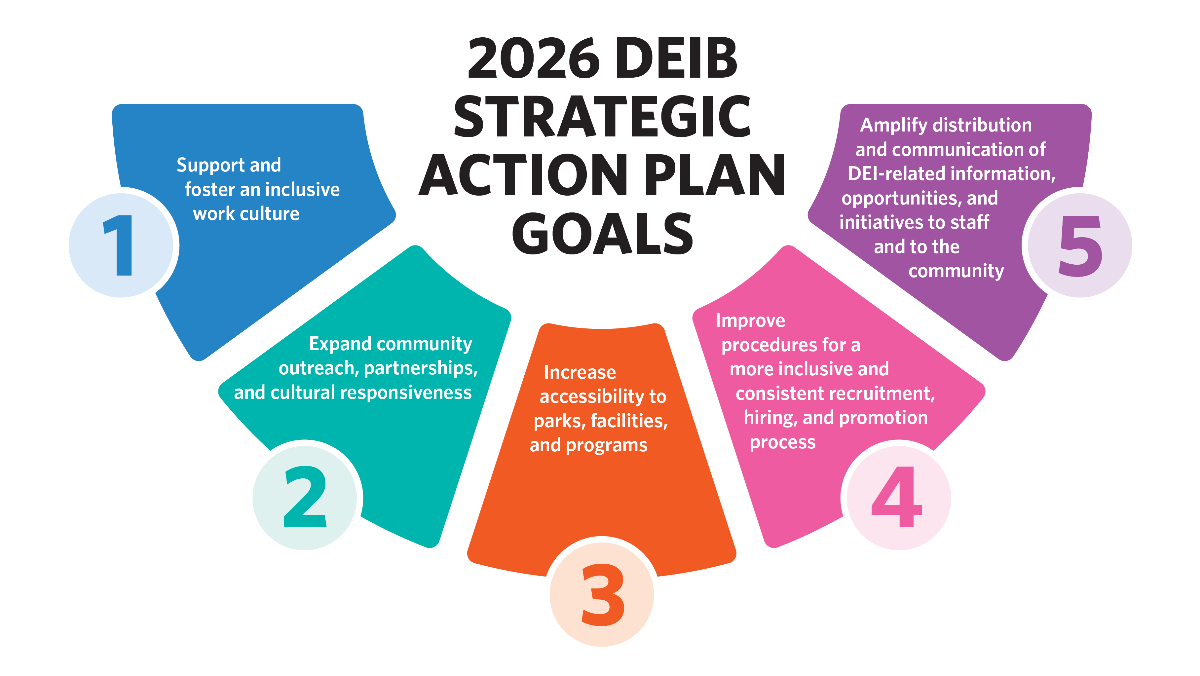
The 2026 DEIB SAP outlines five long-term organizational goals, each supported by specific, actionable, and measurable objectives. Together, these goals serve as a structured roadmap to guide the district’s efforts in fostering a more diverse, equitable, inclusive, and welcoming environment for both community members and staff. It also serves as documentation of Willamalane’s commitment to DEIB principles and intentions to continue assessing this work.
Read the Plan
DEI Documents
| Summary of DEIB SAP | 789.59 KB |
| DEIBSAP_2026 | 5.15 MB |
DEIB Strategic Action Plan Goals
- Support and foster an inclusive work culture.
- Expand community outreach, partnerships, and cultural responsiveness.
- Increase accessibility to parks, facilities, and programs.
- Improve procedures for a more inclusive and consistent recruitment, hiring, and promotion process.
- Amplify distribution of communication and DEIB-related information, opportunities, and initiatives to staff and the community.
Key Partnerships
Equity Community Consortium (ECC)
The Equity and Community Consortium is an information and resource sharing and coordination forum for agencies and jurisdictions that provide governmental and public services in the Eugene-Springfield metropolitan area. The group of participating agencies is comprised of the Bethel School District, City of Eugene, City of Springfield, Eugene School District 4J, Eugene Water & Electric Board, Lane Community College, Lane Council of Governments, Lane County, Lane Education Service District, Lane Transit District, Springfield School District, Springfield Utility Board, University of Oregon, and Willamalane Park and Recreation District.
The main goals of the ECC are:
- To create a safe and supportive space for individuals and agencies to share, learn, build trust and continue elevating their personal and professional equity leadership.
- To develop and share information about equity and service to our community and to create opportunities for the mutual benefit of the participating agencies and the people that they serve.
- To share experience, progress and challenges associated with each agency’s goals to improve and enhance internal working environments and creating more equitable workplaces.
- To improve equity with respect to each agency’s goods, services, bids, and employment, and to build capacity for each agency to engage in equity work.
- To proactively communicate about the importance of equity in our organizations and the community and stand together against hate and bias.
- To work together while also allowing each agency to make informed, independent action-oriented decisions relying on information and idea exchange and mutual support that is created by the ECC.
Other key partnerships include:
- CALC/SAfER
- Springfield School District
- Daisy Chain
- University of Oregon
- The ARC of Lane County
- Transponder
- Oregon Park & Recreation Association
- Circle of Friends
- Brattain House
Willamalane Land Acknowledgment
About the Land Acknowledgement
A land acknowledgment is usually spoken at the beginning of a public event to recognize the event is taking place on the land of Indigenous people, in this case, the Kalapuya people.
This land acknowledgment is to bring awareness to the first peoples of this land we call home. It is important to understand the history that has brought you to reside on the land and to seek to understand your place in that history.
An Indigenous land acknowledgment should be used to recognize the Indigenous past, present, and future of our location and to understand our place in that relationship.
We do not want this land acknowledgment to just be empty words. We want it to be a call to action and next steps, and a contribution to our community. A land acknowledgment is just the beginning.
We hope to inspire others to take action to support Indigenous peoples and communities.
The Willamalane Land Acknowledgement Statement
We are located on Kalapuya Ilihi, the traditional indigenous homeland of the Kalapuya people. The Kalapuya people were dispossessed of their indigenous homelands following the treaties between 1851 and 1855. Then the Kalapuya people were forcibly removed to the Grand Ronde Reservation west of Salem. Today, Kalapuya descendants are primarily citizens of the Confederated Tribes of Grand Ronde and the Confederated Tribes of Siletz Indians, they continue to make important contributions to their communities, our local community, the state of Oregon, and the world. We recognize these lands and waters and their significance for the Kalapuya people who lived and continue to live in this region.
We also express our respect to the many tribes that have ancestral connections to this land, and all Indigenous people who call this land their home.
This was adopted by the Willamalane Board of Directors on Oct. 11, 2023.
Contact Willamalane
If you have ideas, comments, or questions, please contact HR@willamalane.org. Your feedback will help improve the district's diversity, equity, and inclusion conditions.
You are also welcome and encouraged to attend monthly Board of Directors meetings. Monthly meetings have opportunities for public comment, and diversity, equity, and inclusion updates are given periodically.